What the patient came in with
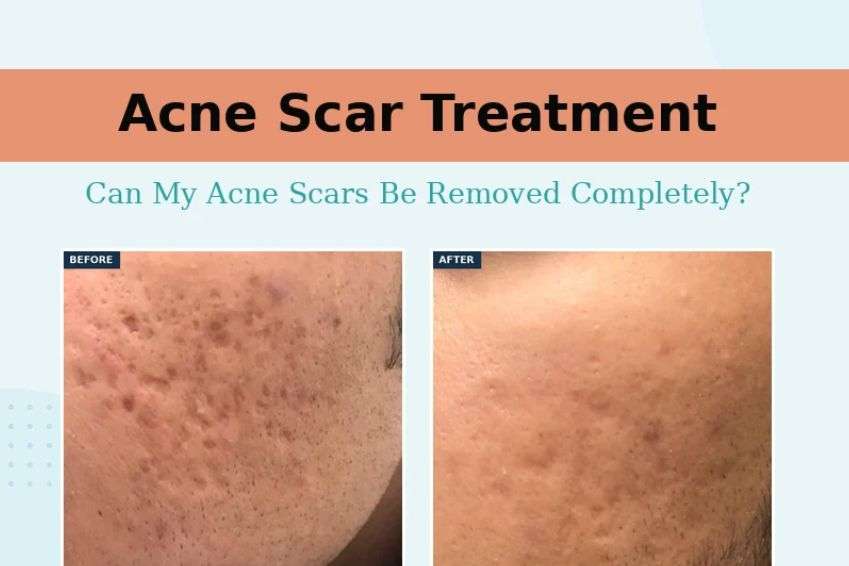
The patient was a man in his twenties. His concern was simple and common: “Doctor, I have a lot of scars. Tell me the best treatment.” He had depressed acne scars spread across both cheeks, with darker marks sitting in and around many of them.
He was also clear about one thing. He was motivated and willing to go through whatever the plan needed, including procedures with some downtime. That matters, because acne scar treatment is a course of several procedures over months, not a single sitting.
What we found on examination
- Multiple scars of different types on both cheeks. The right cheek in particular carried several scar types side by side.
- Box scars. Wider, deeper depressions with sharp, defined edges.
- Ice-pick scars. Tiny, narrow, deep pits that look like small dots on the skin.
- Rolling and shallow scars. Broader, softer dips that give the skin an uneven, wavy surface.
- Reddish-brown marks over many of the scars, visible in the before photographs.
- Factors noted for planning: the type of each scar, where it sits, how old it is, how deep it goes, the patient's age and any skin or health conditions.
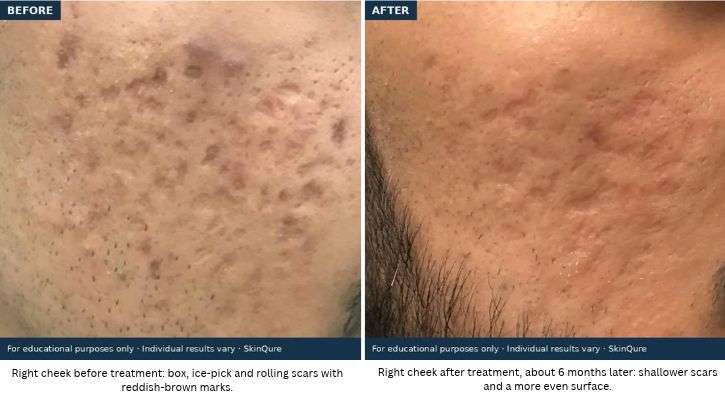
Clinical photographs are reproduced strictly for educational purposes, with the patient's written informed consent. Images have been cropped to the cheek so that the eyes, nose, lips and other identifying features are not visible. They illustrate one patient's presentation and outcome; they are not a diagnosis of your condition and not a promise of a similar result. Lighting and camera differ between the before and after photographs, and individual results vary.
Why “acne scars” is not one problem
People usually say “I have acne scars” as if it were a single condition. On the skin it is several different problems sitting next to each other. A narrow, deep pit behaves very differently from a wide, shallow dip, and a treatment that helps one may do very little for the other.
This is why one laser package for the whole face often disappoints. As Dr. Jangid puts it, there is no such thing as treating “the scars”. Each individual scar has to be identified and then given the option that suits it.
How the plan was made
Three principles drove every decision in this case.
1. Each scar was treated as an individual
The cheeks were examined scar by scar. Box scars, ice-pick scars and rolling scars were each assigned their own treatment rather than one method for everything.
2. The skin was prepared first
Before any procedure, the first question was whether the skin was ready for scar treatment at all. Medicines were used to make the skin healthy first, and only then did procedures begin.
3. Expectations were set before the first session
The patient was told at the start that scars do not disappear completely. The goal was the best achievable improvement, with a realistic range of about 30% to 60–70% depending on the scars and the skin.
What the treatment involved
Step 1 - Examination and scar mapping
An in-person examination was used to classify the scars and decide the order of treatment. Photographs alone are not enough for this; depth and scar type are hard to judge from a picture.
Step 2 - Preparing the skin
Medicines were prescribed to bring the skin into a healthy state before procedures started.
Step 3 - Surgical removal of the box scars
The larger, deeper box scars were removed surgically. A deep scar with sharp walls does not respond well to surface treatments, so removing it and letting the skin heal as a finer line gives a better starting point.
Step 4 - TCA CROSS for the ice-pick scars
The tiny, deep ice-pick scars were treated with TCA CROSS. A small amount of trichloroacetic acid is placed precisely inside each pit so that the scar fills in gradually from its base as new collagen forms.
Step 5 - Laser for the rolling and shallow scars
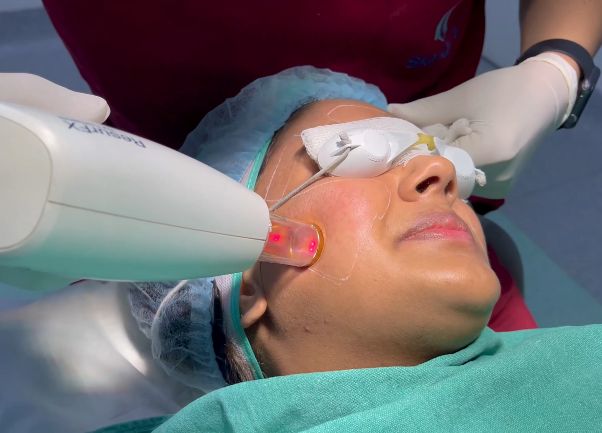
The remaining rolling and smaller scars were treated with laser to resurface the skin and smooth its texture. The clinic has fractional CO2 laser, ResurFX and MNRF available.
Step 6 - Different treatments at different times
The procedures were spaced out over months so the skin could heal between them. There were also gaps when the patient could not come in, which is why the result is reported at about 7 to 8 months rather than 5 to 6.
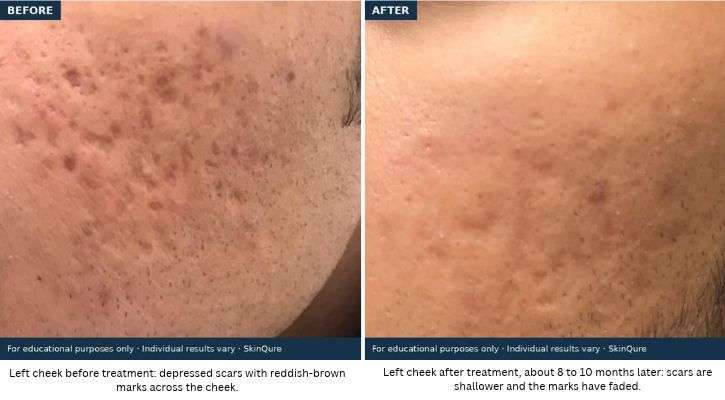
Clinical photographs are reproduced strictly for educational purposes, with the patient's written informed consent . Images have been cropped to the cheek so that the eyes, nose, lips and other identifying features are not visible. They illustrate one patient's presentation and outcome; they are not a diagnosis of your condition and not a promise of a similar result. Lighting and camera differ between the before and after photographs, and individual results vary.
AN HONEST CAVEAT
Acne scars do not go away completely, and nobody should plan treatment expecting that. Even with every option available under one roof (surgery, TCA CROSS, peels, CO2 laser, ResurFX, MNRF and PRP), Dr. Jangid's realistic range is about 30% to 60-70% improvement. Results vary with the type, depth and age of the scars, where they are, the patient's age and skin, and whether sessions are completed. Sometimes the result is less than hoped and sometimes more. This patient reached roughly 50-60% after a full combination plan and strong commitment; residual shallow scars are still visible in the after photographs.
Which treatment suits which acne scar
| Scar type | What it looks like | What was used in this case |
|---|---|---|
| Box scar | Wider, deeper depression with sharp, defined edges | Surgical removal |
| Ice-pick scar | Tiny, narrow, deep pit, like a small dot | TCA CROSS |
| Rolling scar | Broad, soft dip that makes the skin look wavy | Laser treatment |
| Small or shallow scars | Mild surface unevenness | Laser treatment |
What decides how much your scars can improve
| Improvement tends to be better when… | Improvement is usually more limited when… |
|---|---|
| Scars are shallower and more recent | Scars are very deep or many years old |
| Each scar type gets its own matched treatment | One method is used for every scar |
| The skin is healthy and prepared before procedures | Procedures start on skin that is not ready |
| Sessions are completed and spaced as advised | Sessions are skipped or the plan is stopped early |
| Expectations are realistic from the start | The goal is completely scar-free skin |
Signs you may benefit from an acne scar assessment
- Dents or pits on the cheeks, temples or forehead that have not changed for months
- Skin that looks uneven or wavy in side lighting
- Tiny deep pits that makeup settles into
- Scars that remain after the acne itself has settled
- Previous peels or creams that helped the marks but not the dents
None of these alone tells you which treatment you need. That decision needs an in-person examination, because the scar type and depth decide the plan.
Common questions from patients
Can acne scars be removed completely?
No. Acne scars can be improved but not removed completely. With a combination plan matched to each scar type, a realistic range is roughly 30% to 60–70% improvement. Anyone promising 100% removal is overpromising.
What is the best treatment for acne scars?
There is no single best treatment. It depends on the scar type. In this case box scars were removed surgically, ice-pick scars were treated with TCA CROSS, and rolling and shallow scars were treated with laser. Most patients with mixed scars need a combination.
How long does acne scar treatment take?
Usually several months. This patient's result is shown at about 7 to 8 months, including gaps between sessions for healing and a few missed visits.
What is TCA CROSS?
TCA CROSS is a technique in which a small amount of trichloroacetic acid is placed precisely into a narrow, deep scar. It is mainly used for ice-pick scars and encourages the pit to fill in from its base over repeated sessions. It should only be done by a trained doctor.
Why are box scars removed surgically?
Deep box scars have sharp vertical walls that surface treatments struggle to level. Removing the scar and letting the skin heal as a finer mark gives a better base, which laser can then refine.
Is laser alone enough for acne scars?
For mild rolling or shallow scars, laser alone may be enough. For deep box scars and ice-pick scars it usually is not, which is why they were treated with surgery and TCA CROSS first in this case.
Can old acne scars still be treated?
Yes, old scars can still be treated, but the age and depth of a scar affect how much it improves. The plan and the expected result are decided after examination.
Can a doctor plan my acne scar treatment from photos?
Not reliably. Photographs do not show scar depth and type clearly enough to choose between surgery, TCA CROSS and laser. An in-person examination with a dermatologist is the first step.
Do I need to treat active acne before scar treatment?
The skin has to be healthy before scar procedures begin. In this case medicines were used first to prepare the skin, and scar treatment started only after that.
Where we are with this case
About 6 after starting, the patient's scars had improved by roughly 50-60% in Dr. Jangid's assessment. The deep box scars and ice-pick scars are far less prominent, the surface of both cheeks is smoother, and the reddish-brown marks have faded. Some shallow scars remain, as expected.